Introduction to Victim Support at YPS
Here at the YPS, victim care and satisfaction are paramount to the work that we do. If you have been impacted by an incident, and require additional support, our dedicated victim liaison and restorative justice officer will be happy to assist you. You have certain rights as a victim, as detailed below, and we will work to ensure those rights are not only met, but exceeded.
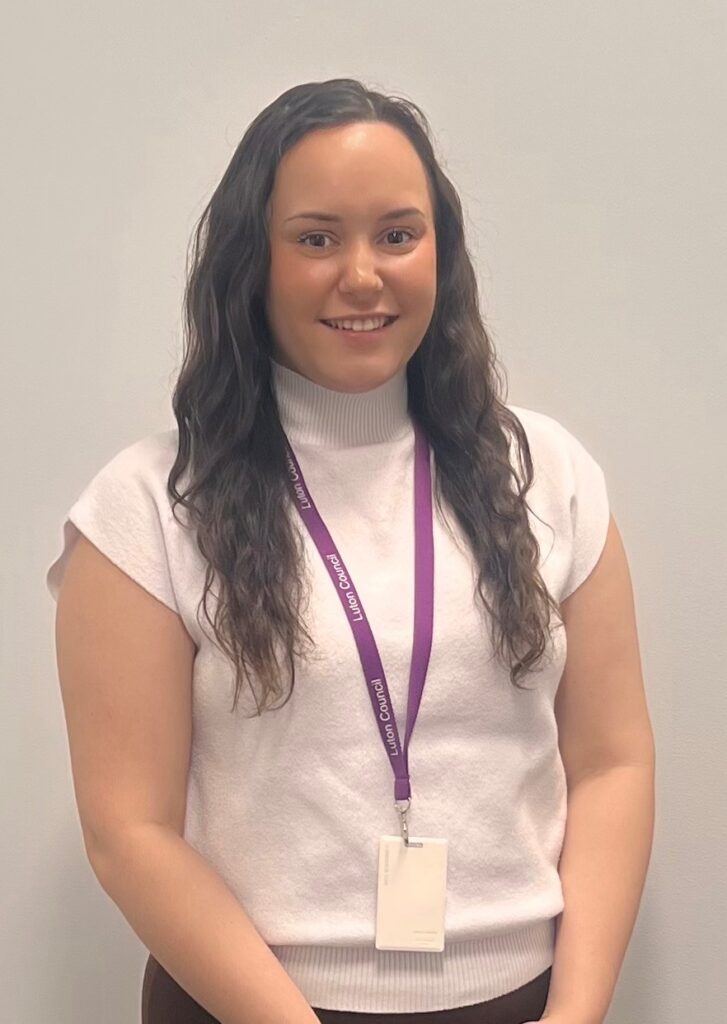
Yasmeen Sheridan
Our Victim Liaison and RJ Officer is here to support you after you may have been affected by a crime. We have also added information to this website with information of organisations that can support you if an incident has not yet been reported to the Police, or if you do not feel comfortable talking directly with us.

Tom Cross (MA)
The role of our Referral Order and Restorative Justice Co-ordinators is predominantly to manage risk, support positive development and reduce reoffending in young people. This includes chairing multi agency meetings, recruiting & supervising panel members, managing Referral Orders and conducting Restorative Justice sessions & practices. This includes managing young people who have caused harm in the community and working with them to repair the harm they may have caused. This can be done through 1 to 1 sessions with the young person, shuttle mediation (i.e. letter of explanation or apology), or through victim-offender mediation.
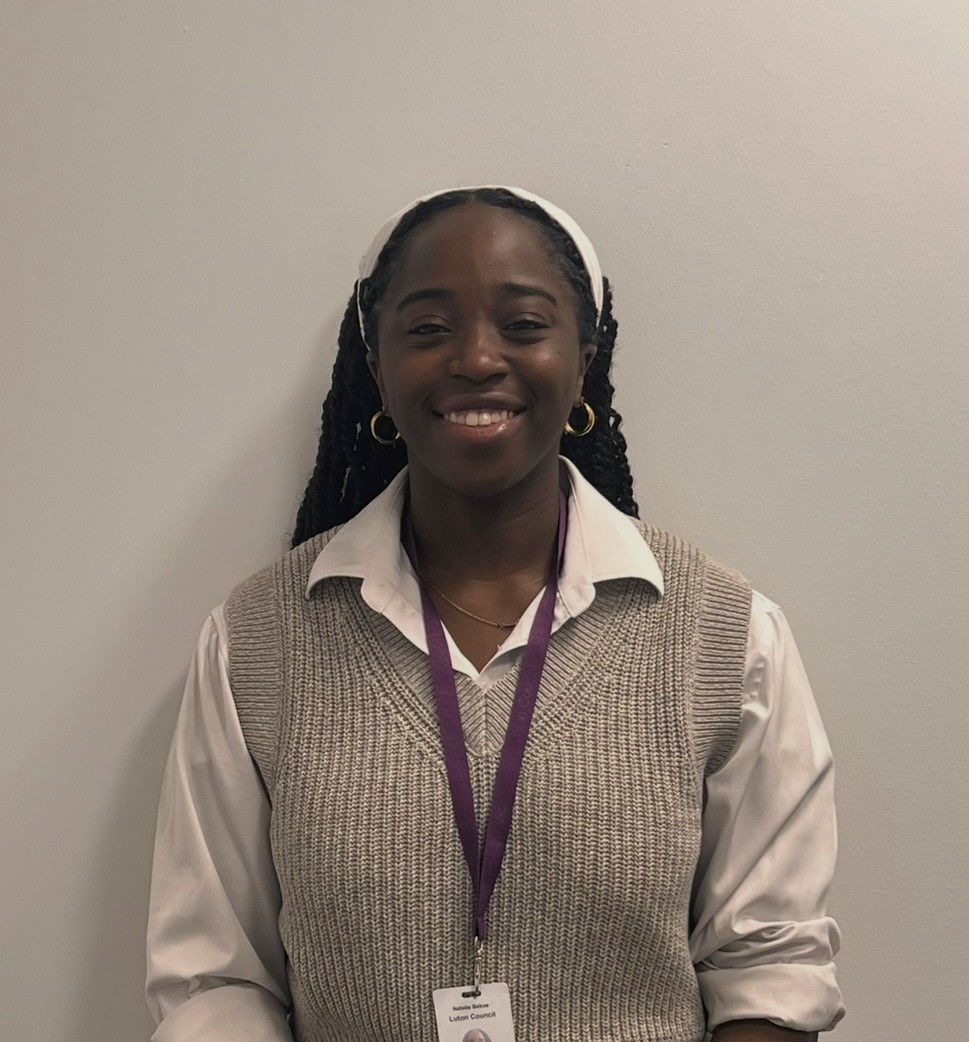
Natalie Bekoe (MA)
The role of our Referral Order and Restorative Justice Co-ordinators is predominantly to manage risk, support positive development and reduce reoffending in young people. This includes chairing multi agency meetings, recruiting & supervising panel members, managing Referral Orders and conducting Restorative Justice sessions & practices. This includes managing young people who have caused harm in the community and working with them to repair the harm they may have caused. This can be done through 1 to 1 sessions with the young person, shuttle mediation (i.e. letter of explanation or apology), or through victim-offender mediation.



Each service provider will have a minimum standard that they must follow when supporting victims of crime. This is covered under the Victim Codes of Practice. This code also focusses on victims’ rights. More information on the Victims Code of Practice can be found at:
https://www.gov.uk/government/publications/the-code-of-practice-for-victims-of-crime
‘I can’t think of anything to improve my experience, when to be honest I wasn’t expecting the support, I received. I really was overwhelmed by the care and attention I was given by Yasmeen. Yes, I was listened to and consulted all the way through, both in regard to the young person and to what I needed. I was given help in the form of exercises and groups I could contact to help with the problems I was experiencing. I can’t praise the service enough and I would recommend people take the help offered because it can help. I found Yasmeen wonderful because she listened and was genuinely compassionate and helpful. Thank you so much’

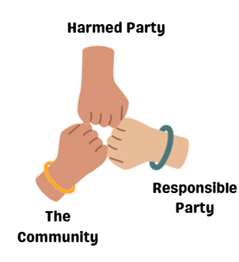
Restorative Justice is the process of bringing together those involved in an incident of harm. This process requires the voluntary participation of both victims and those responsible for causing harm. Restorative Justice between people can include face-to-face meetings, communication through letters or a recording, and can also include a letter of explanation to the victim.
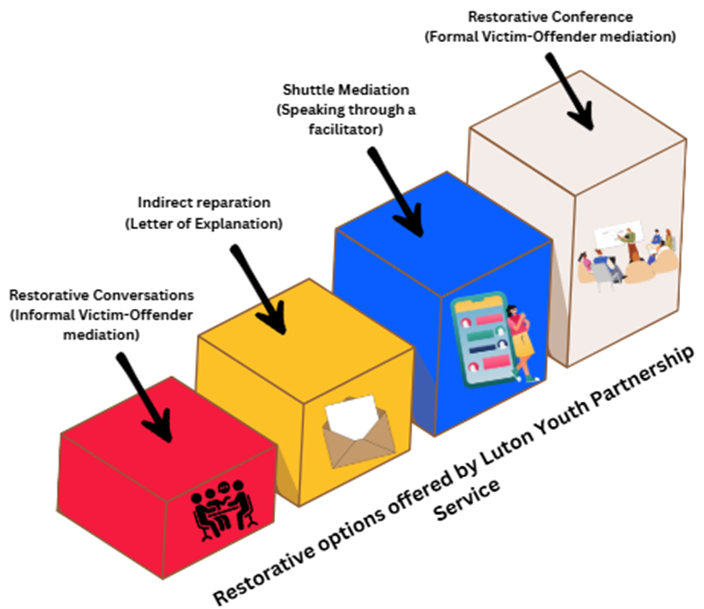
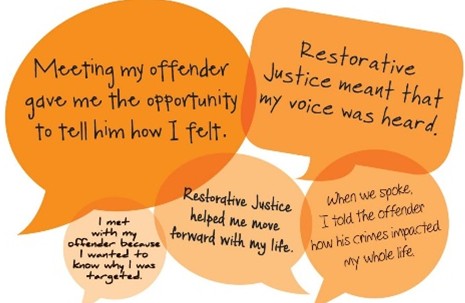
The benefit in participating in Restorative Justice for victims is that the process can help the victims have a voice, facilitate gaining answers, contribute towards the healing process and allow the victim to find a positive war forward. The benefit for young people participating is the intervention will allow them to better understand the impact of their actions, encourages them to take accountability, allows them to repair the harm they have caused to their victim and the community and help reduce the risk of re offending. Restorative Justice can help to bring closure to both the victim and the young person.
The Restorative Justice process is supported by YPS trained facilitators at every stage, who will assist in making sure all voluntary parties involved feel comfortable to seek the most meaningful and positive outcomes for them.
Read about Restorative Justice on the Restorative Justice Council website below:
https://restorativejustice.org.uk/what-restorative-justice
Watch the below videos for a quick overview of what Restorative Justice can look like:
What is RJ –
https://www.youtube.com/watch?v=4VPStZAamxg&t=11s
Moving on from an incident –
The Good Grief Trust –
The Good Grief Trust has a choice of 1000 + charities and tailored local and national support services under one umbrella.
Brake – Victim helpline: 0808 800 0401
Support people bereaved and seriously injured by road crashes.
Samaritans – Helpline: 116 123
Samaritans is a registered charity aimed at providing emotional support to anyone in emotional distress, struggling to cope or at risk of suicide throughout the United Kingdom and Ireland, often through its telephone helpline.
Urgent Mental Health Support – 111 Option 2
Luton Crisis Lounge – 0300 330 0648
All adults (18+) can access the Recovery Lounges to aid in their mental health recovery, help to prevent their mental health worsening or seek support if experiencing severe mental distress. They are open 5pm-11pm 365 days of the year at 46-56 Dumfries Street, Luton, LU1 5BP.
Women’s Aid – Helpline: 01582 391856
Women’s Aid Luton is dedicated to supporting women and children affected by domestic abuse.
ManKind – 01823334244
The Mankind Initiative is a confidential helpline that is available for all men across the UK suffering domestic abuse/violence by their current or former partner; either a female or same sex partner. The helpline is open 10am – 4pm, Monday to Friday.
Respect men’s advice Line – 0808 8010327
Men’s Advice Line is a team of friendly Advisors who will listen and believe you. Our team are available to offer you non-judgmental support, practical advice and information.
Our focus is to increase the safety of men including those who identify as trans and non-binary, who are experiencing domestic abuse (and the safety of any children) by providing confidential support.
Luton
https://www.totalwellbeingluton.org/
Total Wellbeing Luton supports people living in Luton who want to improve their physical and emotional health.
Luton and Bedford All Women’s Centre – Luton 01582 416 783 Bedford 01234 316801
Our centre is open Monday to Friday 9.00 – 5.00. If you need help or advice, or wish to talk to someone, then please do get in touch
Milton Keynes Talking therapies – 01908725099
Talking therapies are effective and confidential treatments delivered by fully trained and accredited NHS practitioners. They can help with common mental health problems like stress, anxiety and depression.
Childline – 0800 1111
You can contact Childline about anything. Whatever your worry, it’s better out than in. We’re here to support you.
There are lots of different ways to speak to a Childline counsellor or get support from other young people.
Kooth –
Kooth is an online counselling and emotional well-being service for children and young people aged 10 to 25, available free at the point of access. Kooth is: Safe, confidential, anonymous.
CHUMS – 01525 863924
CHUMS Mental Health and Emotional Wellbeing Service for children and young people provides therapeutic support in a variety of ways. CHUMS has developed a unique service delivery model to ensure that children and young people are able to access a service that supports their individual needs.
If you feel overwhelmed, or like you want to hurt yourself or someone else, you can:
Bedfordshire Victim Care Services – Call 0800 0282 887
Victim Support – 0808 1689 111
Youth Partnership Service – 01582 547900

Youth Partnership Service
Apex House, Ground Floor, 30-34 Upper George Street, Luton LU1 2RD
01582 547900
YOS@luton.gov.uk
Please view our Privacy and Informed Consent Policy. Website co-produced and managed by Mary Seacole Housing Association.